AI in 2030: Five Predictions That Will Age Terribly
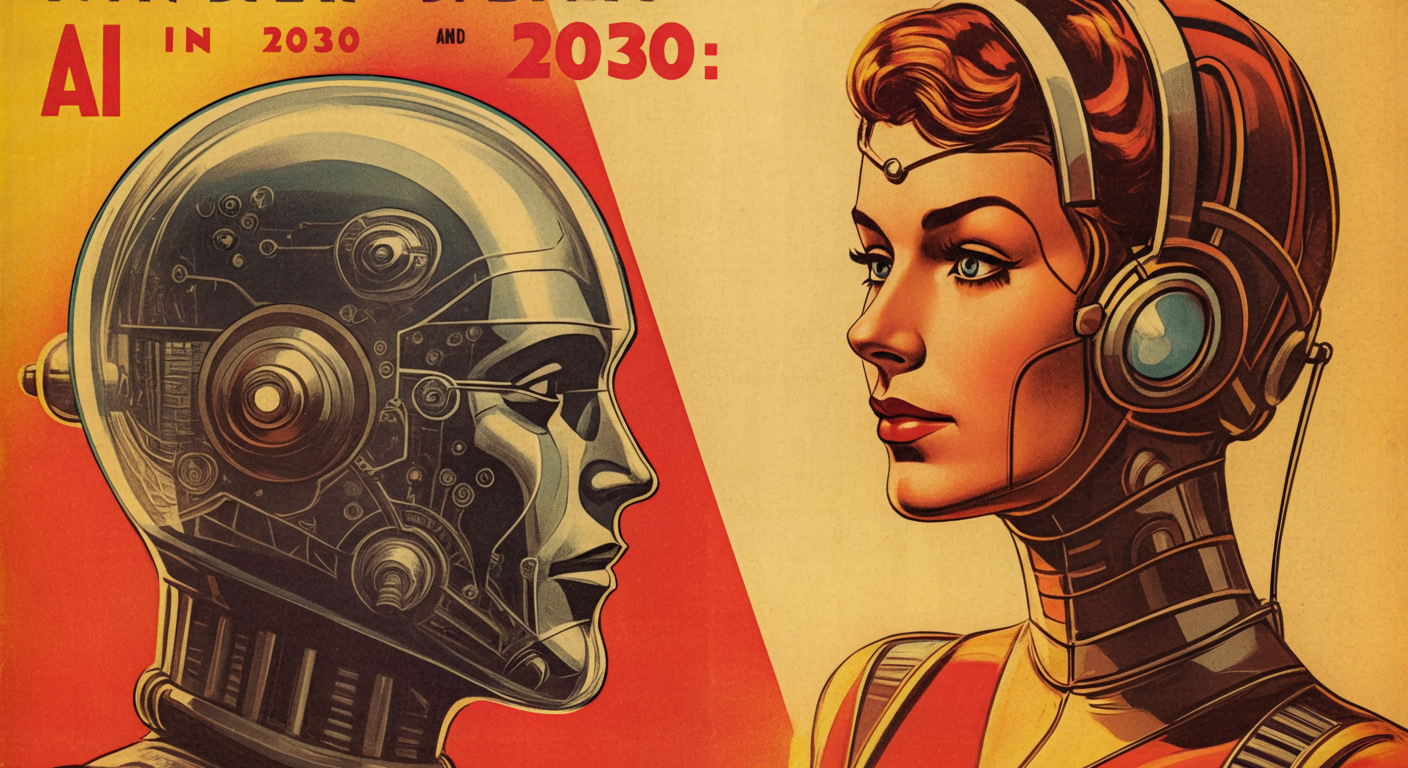
Prediction is hard, especially about the future. But that has never stopped anyone in tech, and it certainly will not stop us. Here are five confident predictions about AI in 2030 that we think will look embarrassingly wrong in hindsight, and the reasoning behind each one is more interesting than the prediction itself.
AGI will arrive by 2027. Every year, AGI is two years away. It has been two years away since at least 2018. In 2026, Anthropic's own submission to the U.S. Office of Science and Technology Policy states the company expects "powerful AI systems" by late 2026 or early 2027, and Dario Amodei has floated end-to-end automation of software engineering as a near-term possibility. Sam Altman has said AGI will "probably get developed" during the current presidential term, then turned around and called AGI "not a super useful term," which is the tell. When the person selling the timeline also disowns the definition, the goalposts are the product. Skeptics like Yann LeCun and Gary Marcus keep pointing out that transformer architectures still hallucinate, still lack embodied reasoning, and still fail in ways no scaling law has fixed. It will still be two years away in 2030.
AI will replace all content writers. AI will change writing. It will not eliminate the demand for a human voice behind it, and the data is already bending the other way. A Binghamton University study found more than half of new articles published online are now AI-written, and readers are developing what amounts to a sixth sense for it. The predictable rhythm, the evenly hedged sentences, the tidy three-item lists, readers clock all of it within a paragraph and bounce. That saturation is exactly why human-written work is becoming the premium product instead of the commodity one. Demand for a real person's judgment does not shrink when a machine can produce infinite competent filler. It grows, because filler is now free and abundant, and judgment still is not.
Self-driving cars will be everywhere. They will be in more places. They will not be everywhere. Waymo just closed a $16 billion round at a $126 billion valuation and is pushing into more than 20 new cities in 2026, including Tokyo and London, targeting roughly a million rides a week by year's end. That is real, and it is not nothing. It is also, after more than a decade of promises, still a company-by-company, city-by-city, permit-by-permit grind through insurance regulators, curb management, and winter weather that does not care about your LIDAR. Infrastructure is hard. Politics is harder. "Everywhere" implies a level of universal deployment that no ground transportation technology in history has achieved this fast, cars included, and cars had a hundred-year head start.
AI companions will replace human relationships. People said the same thing about social media, video games, and television, and in each case the panic overstated the substitution and understated the addition. Humans stubbornly insist on being human, even to a fault, even when the free alternative is patient, available at 3 a.m., and never rolls its eyes. What we are actually watching, per this week's coverage of chatbots quietly filling roles no therapist was ever hired for, is not replacement so much as a gap-filler moving into a gap that was already there before any chatbot existed. Loneliness did not start in 2023. A companion app did not create the demand for companionship. It just made the shortage visible, and a visible shortage is not the same claim as a solved problem.
One company will dominate AI. The history of technology is the history of rotating dominance, not permanent dominance. Ask IBM. Ask Yahoo. Ask Myspace, or BlackBerry, or Netscape, all of which were, at some point, the inevitable future. Today's frontrunner looks different because the moat now includes government relationships and not just market share. Watch what happens when a five percent equity stake for Washington turns a private AI lab into something closer to a sovereign-adjacent utility, and ask whether that arrangement is a permanent lock-in or just this decade's version of "too big to compete with," a phrase that has been wrong before. Today's leader is tomorrow's also-ran often enough that betting on permanence is the riskier trade, not the safer one.
None of these predictions are reckless. That is what makes them worth writing down now, so that in 2030 someone can point back at this page and confirm, once again, that confident tech predictions are a genre of comedy we keep mistaking for forecasting.
Enjoyed this? Get more.
Weekly dispatches on AI culture, chatbots, and the robot future. No hype.


